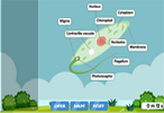
Diagram of a leaf labelling game
Just like humans and animals, plants also come with their own set of organs. Among the most crucial organs a plant can have are their leaves – thin and flattened, these structures are adapted to absorb energy from our own Sun to power the processes of photosynthesis.
Leaves are primarily composed of three parts – the leaf base, the petiole or stalk, and the lamina or leaf blade. Some textbooks or online sources also refer to the leaf base and petiole synonymously as the stalk supporting the midline of the leaf.
Each leaf is attached to its stem by the stalk. The leaf blade projects from this stalk, with the center portion called the midrib. The veins, in turn, project from the midrib. These veins help transport and distribute water and other nutrients from the plant into the leaf. Likewise, they carry the main product of photosynthesis – glucose – to the stem.
Depending on the plant species, veins can be arranged in a number of ways. Dicots usually have reticulate venation, meaning the veins are arrayed randomly. Monocots have parallel venation, in which veins are lined parallel to each other.
We’ve provided this diagram of a leaf labelling game for your kids or students to develop their comprehension on basic botany and better appreciate how leaves contribute to a plant’s health.
In the rapidly evolving landscape of K-12 education, the integration of digital tools has become indispensable. Welcome to your ultimate destination for mastering Diagram Of A Leaf Labelling. Whether you are a dedicated educator seeking to invigorate your classroom dynamics or a parent aiming to support your child's learning journey at home, this page offers a curated selection of resources designed to deliver results. Our platform specializes in gamified learning, a method proven to increase student engagement and retention rates significantly.
This comprehensive guide explores the multifaceted aspects of labelled diagram of leaf structure and related concepts. We have consolidated a vast array of keywords and topics—from fundamental definitions to advanced applications—to ensure you have everything you need in one place. By leveraging the power of interactive play, we transform complex educational standards into accessible, enjoyable experiences for students of all abilities.
The Educational Value of Gamifying Diagram Of A Leaf Labelling
Why choose games over traditional rote memorization? Research consistently demonstrates that interactive learning facilitates deeper cognitive processing. When students engage with our Diagram Of A Leaf Labelling games, they are not merely passive recipients of information; they are active participants in their own education.
Cognitive Benefits
- Active Recall: Games that require quick thinking force the brain to retrieve information rapidly, strengthening neural pathways associated with Diagram Of A Leaf Labelling.
- Immediate Feedback: Unlike paper worksheets, our digital activities provide instant validation. Students know immediately if they have understood diagram of a leaf with labels, allowing for real-time correction and learning.
- Motivation and Engagement: The competitive element of games—earning points, beating high scores—drives intrinsic motivation. Students practice longer and more frequently when the work feels like play.
Core Concepts and Vocabulary
To achieve proficiency in Diagram Of A Leaf Labelling, a strong command of specific vocabulary is essential. Below, we break down the key terms you will encounter in our activities. Mastering these will provide a solid foundation for more advanced study.
- Labelled Diagram Of Leaf Structure: An essential component of the curriculum. Understanding labelled diagram of leaf structure allows students to tackle more complex problems and communicate their ideas effectively.
- Diagram Of A Leaf With Labels: An essential component of the curriculum. Understanding diagram of a leaf with labels allows students to tackle more complex problems and communicate their ideas effectively.
- Labelled Diagram Of A Leaf: An essential component of the curriculum. Understanding labelled diagram of a leaf allows students to tackle more complex problems and communicate their ideas effectively.
- Diagram Of A Leaf Labeled: An essential component of the curriculum. Understanding diagram of a leaf labeled allows students to tackle more complex problems and communicate their ideas effectively.
- Labeled Diagram Of A Leaf: An essential component of the curriculum. Understanding labeled diagram of a leaf allows students to tackle more complex problems and communicate their ideas effectively.
- Label Diagram Of A Leaf: An essential component of the curriculum. Understanding label diagram of a leaf allows students to tackle more complex problems and communicate their ideas effectively.
- Leaf Labeling Diagram: An essential component of the curriculum. Understanding leaf labeling diagram allows students to tackle more complex problems and communicate their ideas effectively.
- Label A Leaf Diagram: An essential component of the curriculum. Understanding label a leaf diagram allows students to tackle more complex problems and communicate their ideas effectively.
By regularly exposing students to these terms in varied contexts—such as Diagram Of A Leaf Labelling memory games, crossword puzzles, and interactive quizzes—educators can ensure that vocabulary moves from short-term memory to long-term retention.
How to Integrate These Resources into Your Curriculum
Flexibility is the hallmark of modern teaching aids. Here is a step-by-step guide on how to effectively utilize our Diagram Of A Leaf Labelling resources in different educational settings.
For Classroom Teachers
Warm-Up Activity: Start your class with a 5-minute session of leaf labelled. It acts as an excellent icebreaker to get students focused.
Guided Practice: Use our interactive diagrams or quizzes on a smartboard. Call on students to solve problems collectively, fostering group discussion and peer learning.
Assessment: Assign specific games as homework or exit tickets. The instant scoring allows you to track progress without hours of grading.
For Parents and Homeschoolers
Create a structured routine where learning feels like a reward. After completing a traditional lesson on Diagram Of A Leaf Labelling, allow your child to 'play' for 15 minutes. This reinforces the lesson immediately. Encourage them to explain the game mechanics to you; teaching back is one of the most effective ways to solidify knowledge.
Frequently Asked Questions about Diagram Of A Leaf Labelling
How can I improve my skills in Diagram Of A Leaf Labelling?
Consistency is key. We recommend setting aside 10-15 minutes daily to engage with our labelled diagram of leaf structure activities. Spaced repetition is highly effective for mastering new material.
Are these resources suitable for all ages?
Yes, while designed with K-12 students in mind, our resources for Diagram Of A Leaf Labelling are scalable. Beginners can start with basic vocabulary matching, while advanced learners can tackle complex logic puzzles and grammar challenges.
Explore Related Topics
Learning is a connected journey. Once you have mastered Diagram Of A Leaf Labelling, we encourage you to explore these related areas to broaden your understanding:
label leaf diagram, leaf labelled.
Our extensive library ensures that whether you are looking for remedial practice or enrichment activities, you will find exactly what you need.
Conclusion
Thank you for choosing us as your trusted partner in education. We are committed to providing high-quality, free access to the best Diagram Of A Leaf Labelling games and worksheets available online. Bookmark this page, share it with your colleagues and friends, and return often—we are constantly updating our database with new activities to keep learning fresh and exciting. Start exploring labelled diagram of leaf structure today and watch your students thrive!